
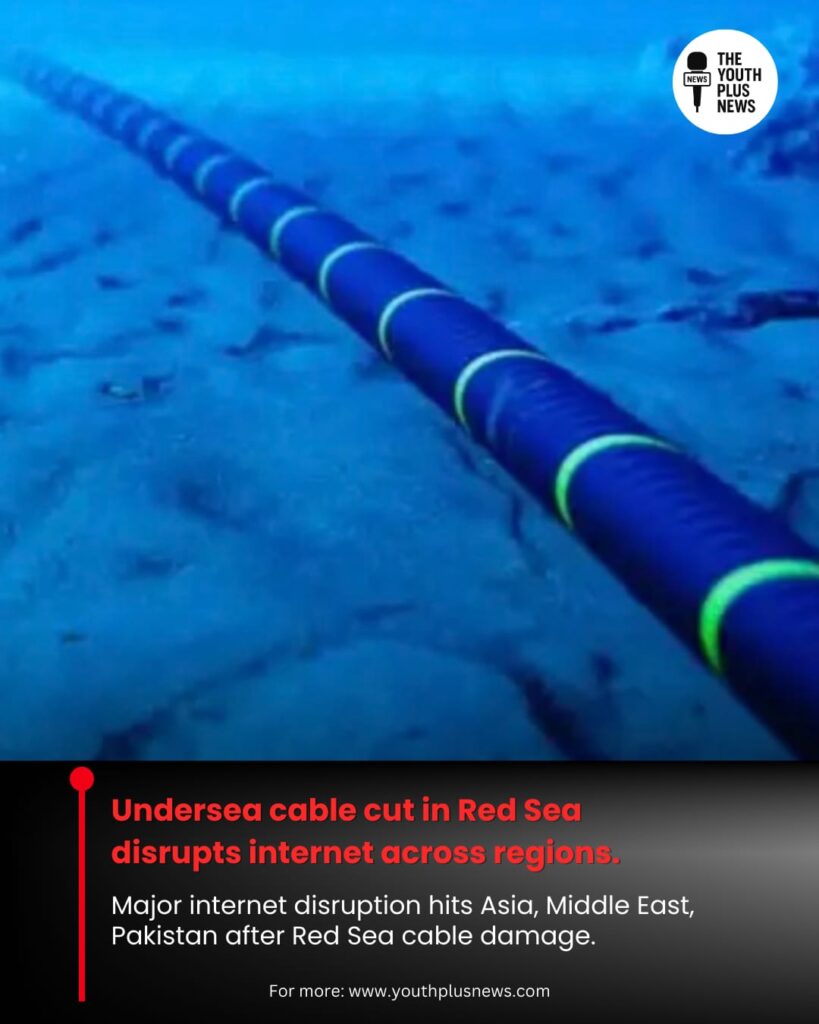
A major undersea cable cut in the Red Sea has triggered widespread internet disruptions across several regions, including Asia, the Middle East, and Pakistan. The outage has affected millions of users, slowing internet services, disrupting businesses, and raising fresh concerns about the security and resilience of global communication infrastructure.📉 The Scale of the DisruptionAccording to early reports from global telecom operators and internet monitoring agencies, the cable cut has led to reduced bandwidth and unstable connectivity across multiple countries. Pakistan, in particular, has experienced significant slowdowns, affecting online services, banking systems, and routine digital communications. Several Middle Eastern nations also reported intermittent outages, while parts of Asia noted degraded performance on major platforms.The Red Sea region is a critical hub for international internet cables, connecting Europe, Africa, and Asia. Any disruption in this area can have a cascading effect on global internet traffic, as rerouting options are limited and often congested.⚡ Possible Causes of the Cable CutThe exact cause of the cable damage is still under investigation. Preliminary assessments suggest it could have been triggered by accidental anchor damage from ships navigating the busy Red Sea lanes, or natural undersea activity. However, some cybersecurity experts have not ruled out the possibility of sabotage, given the strategic importance of these cables.The Red Sea has long been considered a vulnerable chokepoint in the global internet network, with more than 10 major submarine cables passing through its waters. Experts warn that the concentration of infrastructure in such geopolitically sensitive regions leaves the world highly dependent on a fragile system.🏢 Business and Service ImpactThe outage has already caused disruptions in banking services, stock market operations, cloud computing, and cross-border digital transactions. Several multinational companies operating in the Middle East and South Asia reported delays in online operations. For ordinary users, popular social media platforms, video conferencing services, and streaming apps experienced slow loading speeds or complete outages.The economic consequences could be substantial if repairs are delayed. In 2022, a similar disruption in the Mediterranean Sea led to losses worth millions of dollars in affected countries.🔧 Restoration Efforts UnderwayTelecom operators and global internet consortiums have begun rerouting traffic through alternative cable networks to stabilize connectivity. However, experts warn that this solution may only provide partial relief until the damaged section is repaired. Undersea cable repairs are complex, requiring specialized ships and equipment, and often take several weeks depending on weather and maritime conditions.Governments and international agencies are also monitoring the situation closely. Pakistan’s Ministry of Information Technology has already issued a statement urging users to conserve bandwidth and avoid non-essential internet usage until services stabilize.⚠️ A Wake-Up Call for Digital InfrastructureThis incident underscores the vulnerabilities of the modern digital world, where more than 95% of international data travels through undersea fiber-optic cables. Despite being critical to the global economy, these cables remain largely unprotected and exposed to accidental or intentional damage.Experts are now calling for diversification of digital infrastructure, including satellite-based internet systems like Starlink, regional data hubs, and stronger global cooperation to safeguard undersea communication routes.
🌐 ConclusionThe Red Sea cable cut is more than just a technical issue—it highlights the fragility of the world’s digital backbone. As countries scramble to restore services, the incident serves as a stark reminder that the global economy’s dependence on a handful of deep-sea cables makes it vulnerable to both natural and man-made risks.