
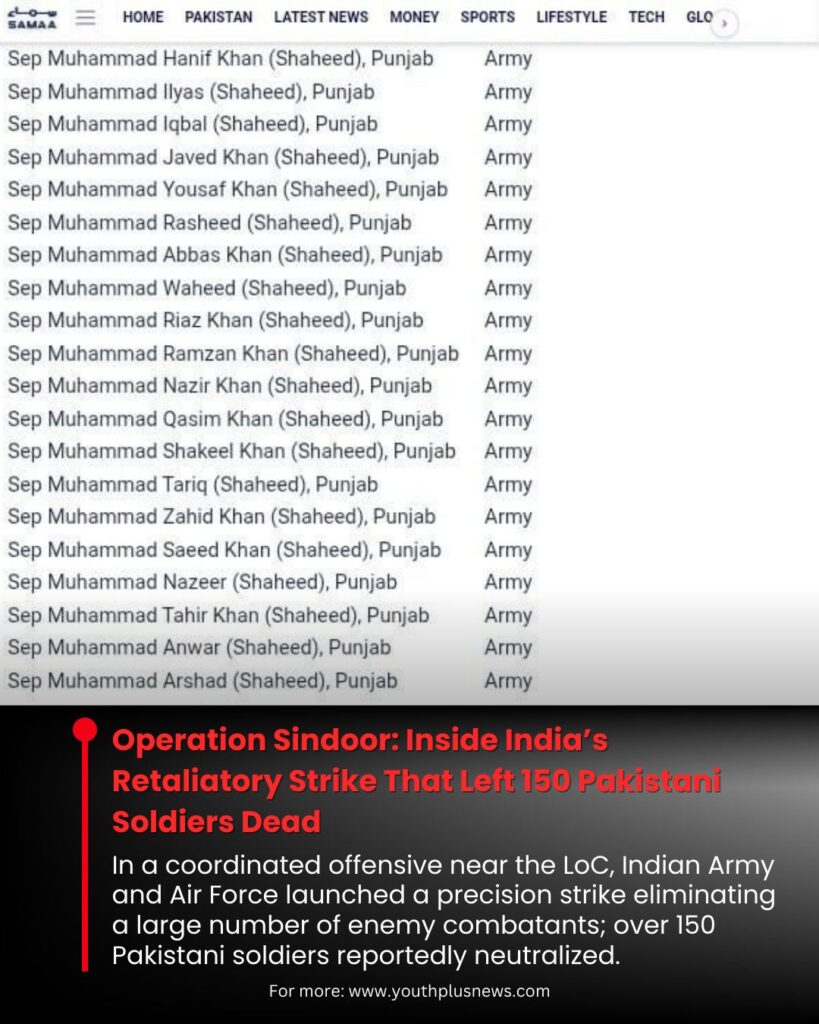
New Delhi — In what has emerged as one of India’s most assertive and strategically calibrated military operations in recent history, Operation Sindoor marked a turning point in the nation’s counter-terror and cross-border security doctrine. The retaliatory strike, jointly carried out by the Indian Army and the Indian Air Force (IAF), led to the elimination of more than 150 Pakistani soldiers, including key personnel operating along the Line of Control (LoC) and in depth positions within Pakistan-occupied Kashmir.
The operation, believed to have been planned in response to a series of cross-border provocations and terror attacks on Indian soil, was executed with high-level coordination between ground forces and aerial units. Strategic targets included forward military outposts, suspected terror launchpads, and logistic nodes known to provide support to infiltrators backed by the Pakistani military establishment.
According to high-level defence sources, Operation Sindoor was launched following credible intelligence inputs regarding the presence of heavily armed terror groups in the proximity of the LoC. These groups were reportedly being facilitated by elements of the Pakistan Army’s Frontier Force Regiment and other active units. The Indian response was swift, targeted, and devastating — both in tactical and psychological terms.
The Indian Air Force deployed precision-guided munitions to neutralize well-fortified targets while ground forces engaged in high-altitude artillery operations. The use of drones, real-time surveillance, and night-vision enabled special ops teams ensured minimal collateral damage while maximizing operational effectiveness.
The Ministry of Defence has maintained a tight lid on the official numbers, but sources indicate that over 150 Pakistani military personnel, including regular soldiers and support staff, were killed during the operation. Among the casualties were senior officers reportedly involved in coordinating logistics for cross-border terrorist infiltration.
Although Pakistan has neither confirmed nor denied the extent of the losses, communication intercepts and satellite imagery reviewed by Indian intelligence suggest large-scale damage to critical infrastructure, including a major ammunition depot and a forward logistics command centre. Several hospitals in PoK and bordering districts reportedly saw an unprecedented influx of casualties in the days following the strike.
Diplomatic reactions have been muted, with New Delhi asserting its right to self-defence and reasserting its zero-tolerance stance on cross-border terrorism. The Indian government has not commented officially on the specifics of Operation Sindoor, citing operational confidentiality, but multiple senior defence officials have hinted at the operation being part of a broader shift in India’s proactive defence strategy.
In the backdrop of ongoing tensions in Jammu and Kashmir and the recent uptick in militant activity along the LoC, Operation Sindoor is being seen not just as retaliation, but as a statement of deterrence. It signals India’s enhanced readiness to pre-empt, engage, and neutralize threats before they cross into Indian territory.
As India continues to adapt its military posture in response to evolving threats, Operation Sindoor stands as a reminder of the country’s growing resolve and capability to defend its sovereignty with force when provoked.