
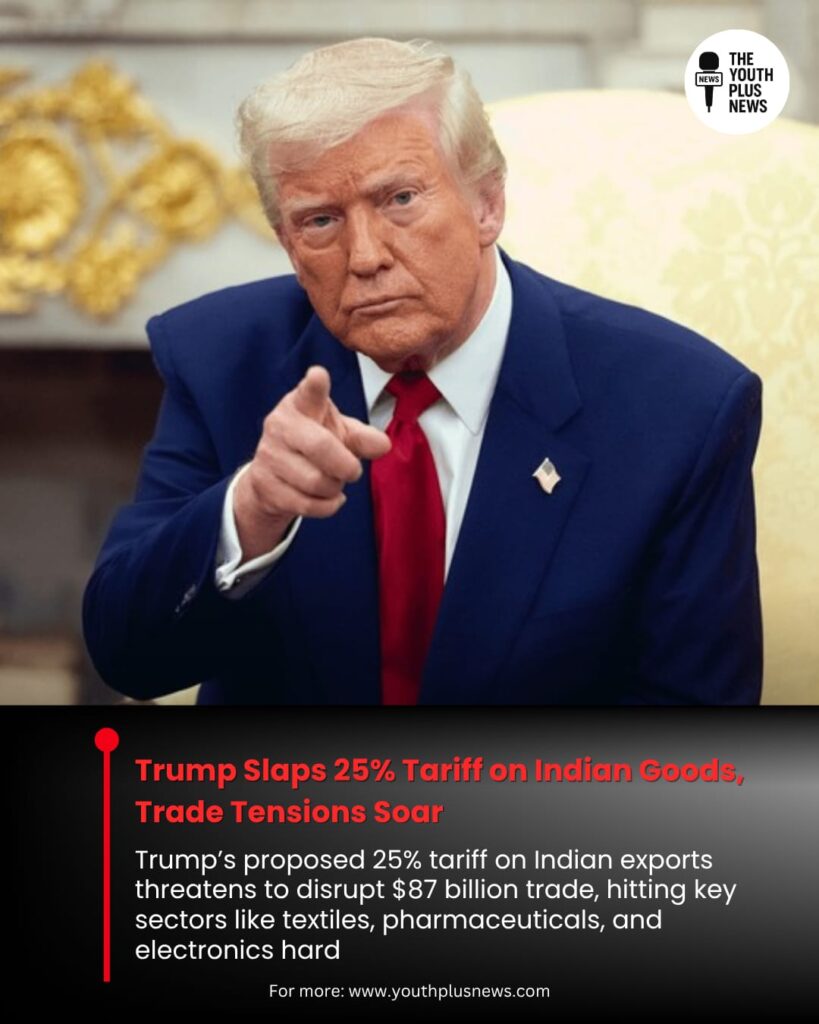
India’s robust trade relationship with the United States is facing renewed strain as former US President Donald Trump proposes a 25% reciprocal tariff on Indian goods, a move that could significantly impact bilateral trade. Just days before a pause on such duties is set to expire, the proposal has sparked concern across industries and policy circles in both countries.
The proposed tariff comes amid stalled trade negotiations between New Delhi and Washington. Trump, known for his aggressive trade stance during his presidency, has re-entered the spotlight with calls for reciprocity in tariffs. His argument is rooted in the belief that Indian exports benefit disproportionately from access to the US market, without offering equivalent benefits to American goods.
This development poses a direct threat to India’s $87 billion export sector to the United States. Key industries like textiles, pharmaceuticals, electronics, auto parts, and engineering goods could be affected. According to trade analysts, even a short-term imposition of such tariffs could disrupt supply chains, increase costs for exporters, and make Indian goods less competitive in the American market.
India’s Key Export Sectors at Risk
India is one of the leading exporters of generic drugs, IT services, and textiles to the US. Sectors such as pharmaceuticals, which heavily rely on the American market for revenue, may face increased scrutiny and reduced profit margins. Similarly, the textile and garment industry, already reeling from global inflation and reduced demand, could find it hard to absorb a 25% hike.
Meanwhile, Indian auto component makers and electronics suppliers, especially small and medium-sized enterprises (SMEs), may face logistical and financial strain, potentially leading to job losses and order cancellations.
A Diplomatic and Economic Challenge
India and the United States have enjoyed strong trade relations in recent years, despite occasional friction. The Biden administration had temporarily suspended several Trump-era tariffs and aimed for broader cooperation in areas like defense, technology, and climate. However, Trump’s re-emergence in the political arena with hardline trade rhetoric may rekindle past frictions.
India’s Ministry of Commerce and Industry has not officially commented on the recent tariff threats, but sources suggest that diplomatic backchannels are active, attempting to prevent further escalation.
Geopolitical Implications
The timing of the tariff threat is critical. With China-U.S. tensions ongoing and the global economy on shaky ground, India has emerged as a strategic alternative manufacturing and trade partner for the West. However, strained relations with the US could alter the narrative, potentially pushing India to diversify its export markets further or strengthen alliances within Asia and Europe.
What Lies Ahead
With an election year unfolding in the US and India looking to boost its economy post-COVID, the proposed tariffs add a layer of uncertainty to an already complex trade environment. Whether this is a negotiation tactic or a genuine policy move, its consequences could reverberate across economies and impact global supply chains.
As experts call for calm, strategic dialogue, one thing is clear — the world will be watching how India responds to this high-stakes economic provocation.