
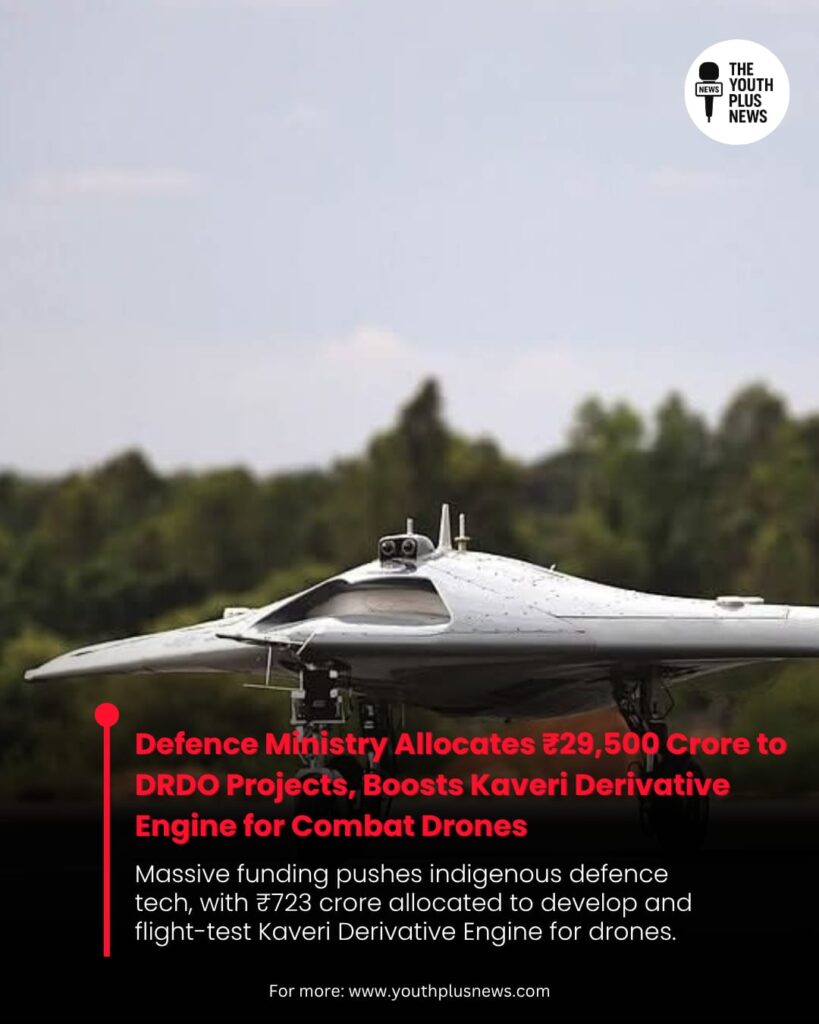
The Indian Ministry of Defence has allocated a significant sum of ₹29,558.66 crore over the past three years to fund Defence Research and Development Organisation (DRDO) projects. This funding is part of the government’s broader initiative to promote indigenous defence technologies and reduce reliance on foreign equipment.
Funding Overview
2023: 40 projects approved with a budget of ₹3,842.71 crore
2024: 43 projects approved totaling ₹22,175.49 crore
2025 (till date): 20 projects approved with ₹3,540.46 crore allocated
Among the key initiatives, two critical projects for the development of the Kaveri Derivative ‘Dry’ Engine have received ₹723.59 crore. These include ₹472.42 crore for the development of a flight-worthy version and ₹251.17 crore for its technology demonstration.
Focus on Kaveri Derivative Engine
The Kaveri Derivative Engine is designed to power India’s upcoming Unmanned Combat Aerial Vehicle (UCAV) platform. Originally developed for the Tejas fighter jet, the Kaveri engine was repurposed into a dry version for drone applications after encountering earlier setbacks.
The current funding aims to complete development and certification phases, with plans for test flights likely by 2026. Ground tests are progressing steadily, and integration with a flying test bed—possibly a modified Tejas aircraft—is under consideration.
Strategic and Technological Significance
The development of the Kaveri derivative engine represents a major step toward self-reliance in critical defence technologies. The dry engine variant is optimized for stealth, efficiency, and low thermal signature, making it ideal for next-generation combat drones. Success in this programme would reduce dependency on imported engines and enhance India’s strategic autonomy in aerospace technologies.
Ecosystem Reform and Collaboration
The Ministry of Defence has implemented various reforms to support defence R&D:
Development-cum-Production Partners (DcPPs) have been introduced to ensure seamless transition from prototypes to full-scale production.
DRDO-Industry-Academia Centres of Excellence have been established to foster innovation at top academic institutions.
Collaboration between DRDO certification agencies and civilian aviation regulators is improving testing and certification of military drones.
Royalty waivers, open access to DRDO patents, and support for startups under the Technology Development Fund are encouraging private sector participation.
These reforms aim to create a strong innovation ecosystem around defence technologies, with DRDO playing a central enabling role.
Why It Matters
The ₹29,558 crore investment reaffirms the government’s commitment to achieving self-reliance in defence production. The Kaveri derivative engine’s progress signifies a major milestone in India’s indigenous aerospace capabilities. If successful, this engine could power future UCAVs, offering cost efficiency, reliability, and complete strategic control.
The combination of financial investment, ecosystem reform, and focused R&D represents a comprehensive approach to transform India into a global hub for defence innovation.