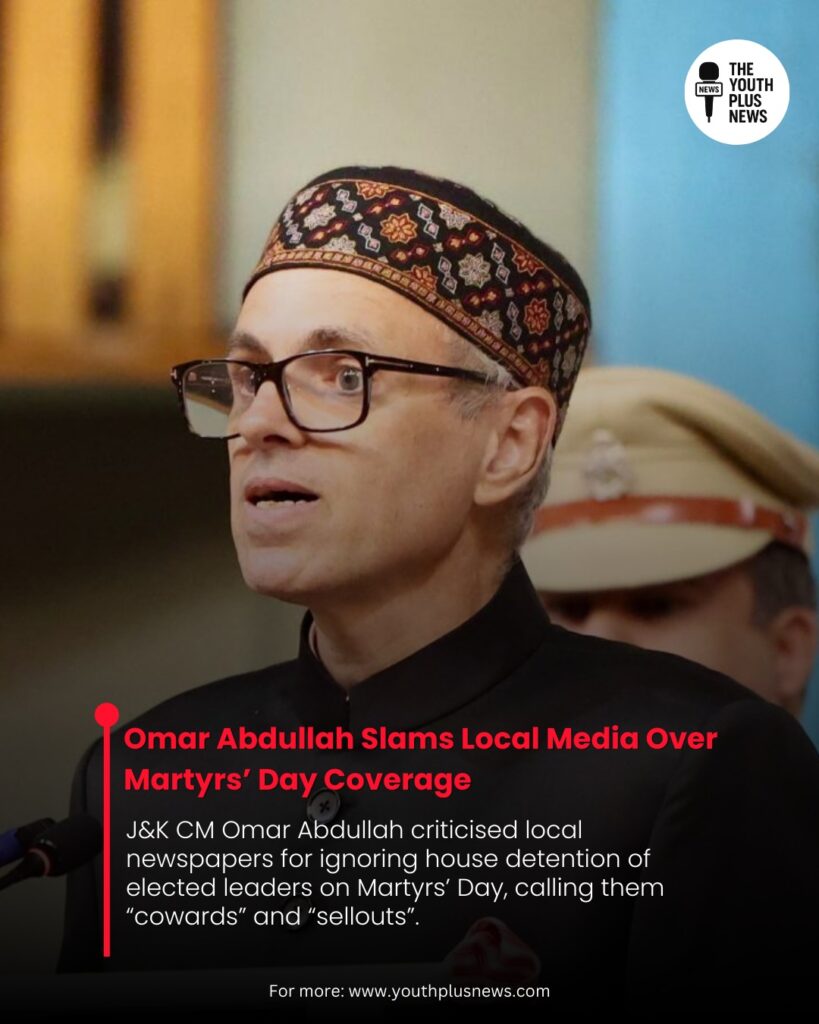
On 14 July 2025, Jammu & Kashmir Chief Minister Omar Abdullah sharply criticised several local media outlets for their handling of coverage surrounding Martyrs’ Day commemorations. He accused them of making it clear who are “cowards” and who have “guts” with their editorial decisions. His remarks came after many elected leaders were reportedly placed under house detention on 13 July, when attempts were made to visit the Martyrs’ Graveyard in Srinagar.
What Omar Said
Taking to X (formerly Twitter), CM Abdullah stated: “Take a look at our local newspapers – both from Jammu & from Srinagar, English & vernacular. You’ll be able to distinguish the cowards from the ones with guts.” He added: “The cowards have completely buried the fact that the entire elected government was locked up yesterday … Shame on the sellouts who buried the story, I hope the size of the envelope was worth it.”
His post highlighted the selective reporting by certain publications that ignored news of the house arrests, while others made it front-page headlines. His direct challenge underscored his frustration with editorial silence, which he contended enabled the government restraint to go unnoticed by the public.
House Detention on Martyrs’ Day
On 13 July—a day marking the 1931 massacre during Dogra rule—reports indicated that Omar Abdullah, his cabinet colleagues, and many opposition leaders were restricted to their homes. The authorities reportedly barred them from visiting the Martyrs’ Graveyard to lay flowers and pay tribute. Political figures, including Sajad Lone, Mohammad Yousuf Tarigami, and Tanvir Sadiq, confirmed their detentions, calling the action “undemocratic” and likening it to a repeat of historical injustices.
Abdullah condemned these measures as the “tyranny of the unelected,” accusing the Lieutenant Governor’s administration of undermining democratic norms and denying public tribute to the 22 martyrs who died on 13 July 1931.
Media and the Message
The CM’s words spotlighted a press divide—some newspapers faced public backlash for allegedly “burying” the detention story, whereas others upheld journalistic duty by featuring bold coverage. His use of terms like “cowards” and “sellouts” was a blunt rebuke, suggesting that some outlets may have been influenced by political or financial pressures.
Analysts suggest the choice of what makes the headline is itself a political act, reflecting broader tensions in a region where free media operates amid administrative controls.
Broader Context
July 13 has deep historical significance in J&K, marking the day when 22 Kashmiris were killed while unity protesting Dogra rule in 1931—an event deeply embedded in Kashmir’s political memory. Following the abrogation of Article 370 in 2019, Martyrs’ Day ceased to be an official holiday, and access to the cemetery has been frequently restricted.
This incident underscores continued challenges around press freedom, democratic expression, and regional governance in Jammu & Kashmir. The CM’s criticism adds to growing concerns over the role of media at a time when administrative authority can limit public rituals and political movement.
What Happens Next
With the session of Parliament ongoing, and debates over Jammu & Kashmir’s autonomy and governance already in focus, Abdullah’s accusations are likely to spark widespread discussion. Media bodies and civil society are expected to respond, highlighting the need for transparency, accountability, and unbiased reporting—especially during politically charged events.