
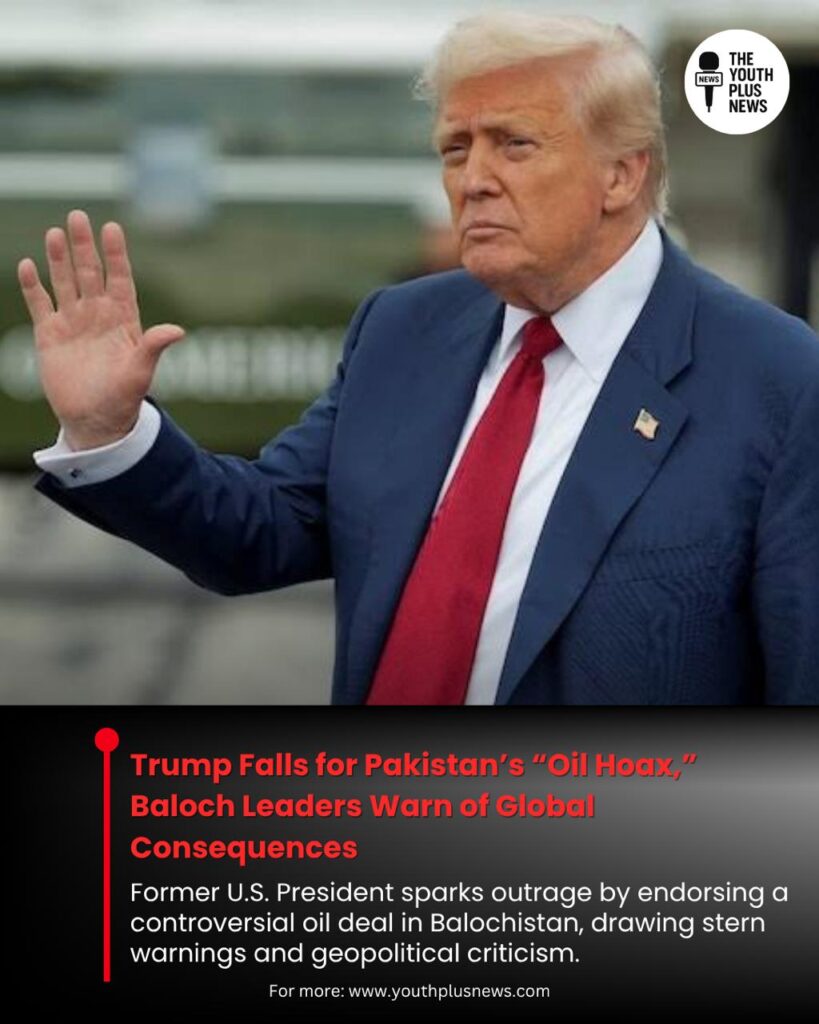
In a dramatic turn of international affairs, former U.S. President Donald Trump has come under fire after endorsing a controversial trade deal with Pakistan aimed at developing so-called “massive oil reserves.” The move has sparked widespread backlash, especially from Baloch leaders who argue that the resources in question lie within the sovereign territory of Balochistan, not Pakistan.
The incident began after Trump publicly lauded Pakistan’s alleged oil potential and announced a U.S.-Pakistan trade agreement to explore and develop these reserves. However, Mir Yar Baloch, a prominent Baloch leader, quickly dismantled Islamabad’s claims, calling it a “strategic hoax” and a blatant case of resource theft. Baloch issued a strong statement warning of “strategic consequences” and accusing the Pakistani military of using the deal to funnel wealth into terror networks.
“The oil, gas, and mineral reserves belong to the Baloch people — not the Pakistani state,” Mir Yar Baloch stated in a viral post on X (formerly Twitter), adding, “#BalochistanIsNotPakistan.”
According to Mir Yar Baloch, the minerals and fossil fuel deposits in the region — including valuable rare earth elements, lithium, copper, uranium, and crude oil — cannot be bartered away by a government that has no legitimate claim over Balochistan. He declared the Pakistani state guilty of misinforming not only its own people but also misleading top-level officials in the U.S. and the United Nations.
The backdrop to this uproar lies in Balochistan’s long-standing struggle for independence. In May 2025, the region unilaterally declared independence from Pakistan, citing decades of systemic marginalization, human rights violations, and economic exploitation by Islamabad. Since then, Baloch leaders have been pushing for international recognition of Balochistan as a sovereign entity.
The Trump-endorsed deal is seen by Baloch activists as a dangerous validation of Pakistani occupation. “Empowering the ISI (Pakistan’s Inter-Services Intelligence) with such deals only fuels the machinery that sponsors extremism and suppresses indigenous voices,” Baloch warned.
Strategic analysts also raised red flags, citing implications for regional stability. “This is not just an economic misstep — it’s a geopolitical blunder,” said a former Indian intelligence officer, pointing out that any Western endorsement of Pakistan’s claims over Balochistan could legitimize state-backed militancy and weaken counterterrorism efforts.
The controversy has reignited calls in India and other parts of the world for a deeper investigation into Pakistan’s true motives behind its resource claims. Many international observers now fear the deal could fuel proxy conflicts and deepen fault lines in an already volatile South Asia.
Trump’s critics argue that the former president failed to conduct due diligence before making the announcement, risking U.S. credibility and potentially financing terror-linked infrastructure under the guise of “economic development.”
For now, the international community watches closely as the Baloch leadership ramps up its diplomatic campaign to prevent what it sees as a dangerous precedent — one that allows occupiers to monetize stolen land while silencing indigenous rights through strategic deceit.